Electric Full-Length Turning Care Bed with Folding Aluminum Side Rails
Product Overview
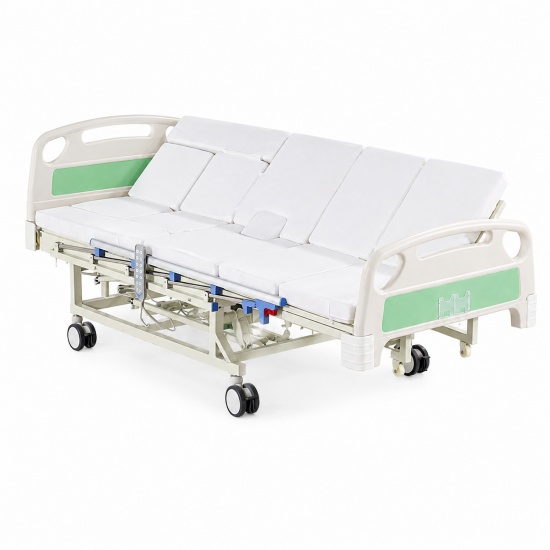
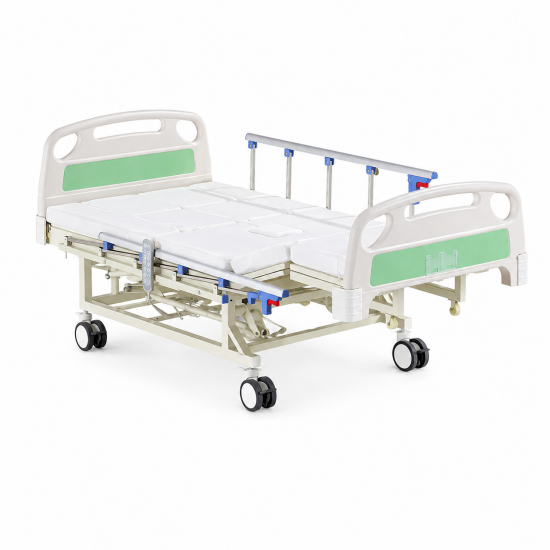
Multifunction Turning Care Bed for Patients Requiring Daily Positioning Assistance
Patients with severely limited mobility often need more than conventional backrest and leg adjustment. Regular repositioning, assisted sitting, leg positioning, toileting and bedside care can become part of the daily nursing routine, particularly during long-term recovery or extended periods of bed rest.
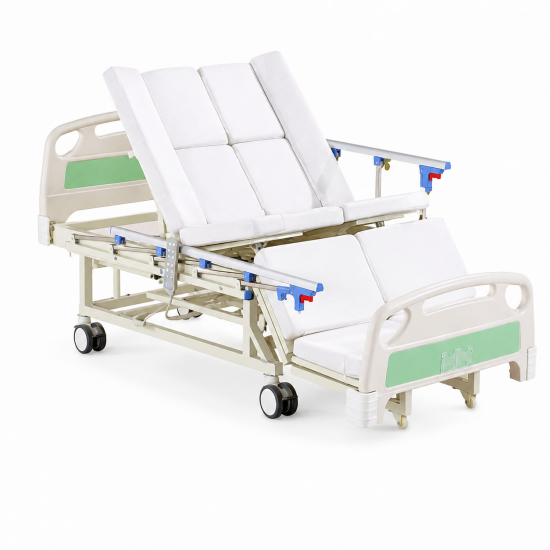
This electric full-length turning care bed combines these requirements in one integrated platform. Its core functions include powered left and right turning, backrest adjustment and leg positioning, together with practical care features for toileting, meals and other bedside activities.
Unlike our extra-wide turning models, this configuration uses a standard care-bed width, making it suitable for users who require advanced repositioning assistance without the additional space of a wider sleeping platform.
Full-Length Left and Right Turning System
Coordinated Repositioning Along the Bed Surface
The defining feature of this model is its electric lateral turning system. Instead of creating movement only around the upper body or hip area, the turning structure extends along the main length of the sleeping platform to assist repositioning from the upper body toward the lower limbs.
When the left or right turning function is activated, the supporting sections work together to create a coordinated lateral position. This makes the bed particularly suitable for patients who have difficulty changing their lying position independently.
Designed for Repeated Repositioning Requirements
For patients who remain in bed for extended periods, repositioning may need to be performed repeatedly throughout the day. An electric turning mechanism gives caregivers a practical way to assist this movement while reducing dependence on completely manual repositioning.
For hospitals, rehabilitation centers and long-term care facilities comparing different Turning Nursing Bed configurations, the turning structure is an important factor to evaluate because not every turning bed supports the body in the same way.
Standard-Width Platform for Conventional Care Spaces
Advanced Turning Function Without an Extra-Wide Bed Frame
This model retains a standard bed width rather than using the enlarged sleeping platform found on our wide-body turning care beds.
The configuration is intended for standard-size patients who need full-length turning assistance but do not require additional bed width. This helps maintain a more conventional footprint in patient rooms and care areas.
Suitable for Institutional Bed Layouts
For healthcare facilities purchasing multiple beds, overall dimensions can influence room planning, caregiver access and equipment placement. A standard-width turning bed can be easier to integrate into existing care environments where space around each bed needs to remain available for nursing activities.
Electric Backrest Adjustment for Assisted Sitting
The backrest can be raised electrically to support the patient in a more upright position. This function can be used for meals, communication, reading and other bedside activities where a flat lying position is not suitable.
Reducing Repeated Manual Upper-Body Lifting
For patients unable to sit up independently, manually lifting the upper body can become a frequent nursing task. Powered backrest adjustment allows the caregiver to establish the required position through the handset while supervising the patient throughout the movement.
The backrest function can also be used together with the leg section to create different positions according to the patient's daily care requirements.
Adjustable Leg Positioning
The lower section of the bed can be adjusted to raise or lower the legs. Combined with backrest positioning, this provides greater flexibility than a basic fixed care bed.
Multiple Positions from One Care Platform
During long-term care, the required position may change several times throughout the day. The patient may need to lie flat while resting, raise the upper body during meals, change the leg position for comfort or use the turning function when assisted repositioning is required.
Integrating these movements into one bed allows caregivers to adapt the sleeping surface without repeatedly transferring the patient between different pieces of equipment.
Folding Aluminum Alloy Side Rails
This model is equipped with folding aluminum alloy side rails, distinguishing it from configurations that use larger two-piece ABS side rails.
Open Structure with Convenient Bedside Access
When raised, the side rails provide a protective barrier along the bedside. When direct access to the patient is required, the rails can be folded down to create a more open working area.
This can be useful during repositioning, clothing changes, personal hygiene and other hands-on nursing procedures.
A Practical Alternative to ABS Side Rails
Different care environments have different side-rail preferences. ABS side rails provide a larger molded protective surface, while folding aluminum alloy rails offer a lighter and more open structure with convenient access from the side of the bed.
For distributors and project buyers, both configurations can therefore be selected according to local market preferences and intended care applications.
Integrated Toileting Function for Bedridden Patients
Patients with severely restricted mobility may have difficulty transferring safely from the bed to a conventional toilet. For these users, toileting support becomes an important consideration when selecting a multifunction care bed.
This model incorporates a toileting opening into the bed platform. When required, the corresponding section can be opened for assisted bedside toileting. When the function is not being used, the area remains part of the normal sleeping surface.
Reducing Unnecessary Patient Transfers
The purpose of this function is not simply to add another feature to the bed. It is designed around a practical care problem: some patients require substantial assistance every time they are moved away from the bed.
Providing a bedside toileting option can help caregivers manage this part of daily care without requiring a complete transfer for every use.
Overbed Table for Meals and Daily Activities
The bed can be configured with an overbed table for meals, drinks and commonly used personal items.
Combining Sitting Position with Bedside Activity
When the backrest is raised, the patient can be supported in a more upright position while using the table. This makes the combination practical for eating, reading or other activities performed from the bed.
For long-term users, these seemingly simple functions can have a significant effect on how practical the bed is during everyday care.
Bedside Hair-Washing Support
Personal hygiene can be difficult when a patient cannot safely leave the bed. This model can be used with a dedicated washing basin to assist with hair washing directly at the bedside.
Designed Around Routine Nursing Tasks
For caregivers, maintaining hygiene for a highly dependent patient can involve repeated transfers and considerable physical assistance. A bedside washing solution provides an alternative when moving the patient into a bathroom is difficult or unnecessary.
IV Pole for Additional Patient Care
An IV pole can be integrated into the bed configuration to support infusion-related requirements where applicable. This makes the bed more adaptable to institutional care, rehabilitation and other environments where patients may require additional bedside support.
How This Model Differs from a Conventional Hospital Bed
A conventional electric Hospital Bed typically focuses on clinical positioning functions such as backrest adjustment, leg adjustment, height adjustment and, on advanced models, Trendelenburg positioning.
This product addresses a different care requirement.
Conventional Hospital Bed
The main emphasis is patient positioning, medical treatment support, transfer convenience and general ward operation.
Full-Length Turning Care Bed
The emphasis shifts toward long-term bedridden care, especially for users who require frequent assisted turning, toileting support and help with routine daily activities.
For this reason, we classify this product within our dedicated Turning Nursing Bed series rather than treating it as another standard hospital bed configuration.
Suitable Applications
Hospitals and Step-Down Care Units
The bed can be considered for patients whose treatment or recovery requires extended periods of bed rest together with regular repositioning assistance.
Rehabilitation Centers
Patients undergoing longer recovery programs may benefit from a bed that combines positioning, turning and daily living support in one platform.
Long-Term Care Facilities
For residents with substantial mobility limitations, the turning and integrated care functions can support routine caregiver workflows.
Home Healthcare
The standard-width configuration can also be suitable for home-care environments where advanced nursing functions are required but available room space does not justify an extra-wide bed.
Important Points for Buyers Comparing Turning Care Beds
Check the Actual Turning Structure
The term “turning bed” alone does not describe how the mattress platform moves. Buyers should confirm whether the product provides partial-body turning, segmented turning or coordinated full-length lateral repositioning.
Confirm Whether Extra Width Is Necessary
A wider bed is not automatically a better choice. Extra-wide configurations are useful for larger users who require additional sleeping space, while standard-width models can provide a more practical solution for general patient populations.
Compare Side-Rail Configurations
Two-piece ABS side rails and folding aluminum alloy rails serve different procurement preferences. Buyers should consider protection, bedside access, appearance, maintenance and the requirements of their local market.
Evaluate Daily Care Functions, Not Only Motor Quantity
For a turning care bed, the number of electric actuators alone does not determine its practical value. Buyers should consider how the bed assists with the actual care routine, including turning, sitting, leg positioning, toileting, meals and hygiene.
A Purpose-Built Solution for Complex Bedside Care
This electric full-length turning care bed is designed for patients whose needs extend beyond ordinary sleeping-position adjustment. Its coordinated left and right turning system assists full-body repositioning, while powered backrest and leg functions support different positions throughout the day.
The standard-width frame makes the bed easier to integrate into conventional patient rooms, while folding aluminum alloy side rails provide a practical balance between bedside protection and caregiver access. Toileting, dining, washing and IV-support options further extend the bed from a positioning product into a more complete daily-care platform.
For hospitals, rehabilitation centers, long-term care facilities, medical equipment distributors and project buyers, we can provide different turning structures, side-rail configurations and multifunction care-bed solutions according to purchasing requirements.
For specifications, wholesale pricing, OEM/ODM requirements or project inquiries, please contact us for further information.
Frequently Asked Questions
Yes, we support comprehensive OEM and ODM customization services. We can adjust bed size, load-bearing capacity, number of adjustment functions, bed surface material, guardrail style and overall color according to your demands. For medical institutions, we can also add matching auxiliary accessories
We support door-to-door global shipping covering Europe, North America, Southeast Asia, Middle East and other regions. All medical beds are shipped with modular packaging to reduce transportation damage. We provide free detailed English paper installation manuals and step-by-step installation video
Our full range of medical beds supports multi-scenario use. Electric medical beds and manual hospital beds are specially designed for general wards, intensive care units and emergency rooms of public and private hospitals. Nursing beds with side rails and anti-fall functions are perfect for nursing
Related Products You May Like
Multi-Position Electric Turnin...
Multi-Position Turning Bed for More Demanding Daily CarePatients and elderly use
Electric Patient Repositioning...
Electric Patient Repositioning Bed for Long-Term Nursing CarePatients who spend
Electric Full-Length Turning C...
Multifunction Turning Care Bed for Patients Requiring Daily Positioning Assistan